










Methodology
Google Economic Impact Report | European Union 2025
Enabling an AI-first and future ready European economy

A study by Implement Consulting Group, commissioned by Google1

Debbie Weinstein
President, Google EMEA
The European Union is one of the world’s largest and most digitally connected economic areas.
This year Google proudly celebrates 25 years in the region since our first Google employee started in Hamburg. Today, that footprint spans 26 offices across 17 member states, eight data centres, and supports over 100,000 European jobs. Our relationship with Europe is one of partnership - we live here, we build here and we’re part of the communities we serve.
Our latest EU Economic Impact Report, developed by Implement Consulting Group, demonstrates how European businesses and institutions are using Google’s digital technologies to grow and succeed. It also showcases how Google’s products and platforms, investments in infrastructure and Cloud and AI technologies are enabling economic growth and innovation, ultimately contributing more than €200 billion to the EU’s GDP in 2025.
Looking ahead, AI could boost the European economy by €1.2 trillion annually within a decade. However, delivering on AI’s promise for all Europeans requires both a regulatory environment that champions business success and innovation and a shared commitment to equip people with the best digital tools and the skills to use them. Since 2014, Google has trained over 13 million people in the EU on essential digital and AI skills and we continue to partner with European institutions, businesses, and communities to ensure that everyone can benefit from the AI Era.
I see incredible opportunities for Europe’s visionary founders and leaders who are building the businesses that will drive our future economy. Organisations large and small are already turning this potential into measurable progress: From Renault Group using Google AI to cut factory downtime, resulting in record manufacturing timelines, to entrepreneurs like Danilly Carvalho, who uses Google AI tools to scale her skincare brand IPERA from County Clare, Ireland to the world. This is an expansionary moment and we are honoured to be Europe’s partner on this journey.
Our latest EU Economic Impact Report, developed by Implement Consulting Group, demonstrates how European businesses and institutions are using Google’s digital technologies to grow and succeed. It also showcases how Google’s products and platforms, investments in infrastructure and Cloud and AI technologies are enabling economic growth and innovation, ultimately contributing more than €200 billion to the EU’s GDP in 2025.
Looking ahead, AI could boost the European economy by €1.2 trillion annually within a decade. However, delivering on AI’s promise for all Europeans requires both a regulatory environment that champions business success and innovation and a shared commitment to equip people with the best digital tools and the skills to use them. Since 2014, Google has trained over 13 million people in the EU on essential digital and AI skills and we continue to partner with European institutions, businesses, and communities to ensure that everyone can benefit from the AI Era.
I see incredible opportunities for Europe’s visionary founders and leaders who are building the businesses that will drive our future economy. Organisations large and small are already turning this potential into measurable progress: From Renault Group using Google AI to cut factory downtime, resulting in record manufacturing timelines, to entrepreneurs like Danilly Carvalho, who uses Google AI tools to scale her skincare brand IPERA from County Clare, Ireland to the world. This is an expansionary moment and we are honoured to be Europe’s partner on this journey.
Key findings
Google is enabling European businesses and institutions to grow
ECONOMIC GROWTH
Over €200 billion contribution to EU GDP in 2025
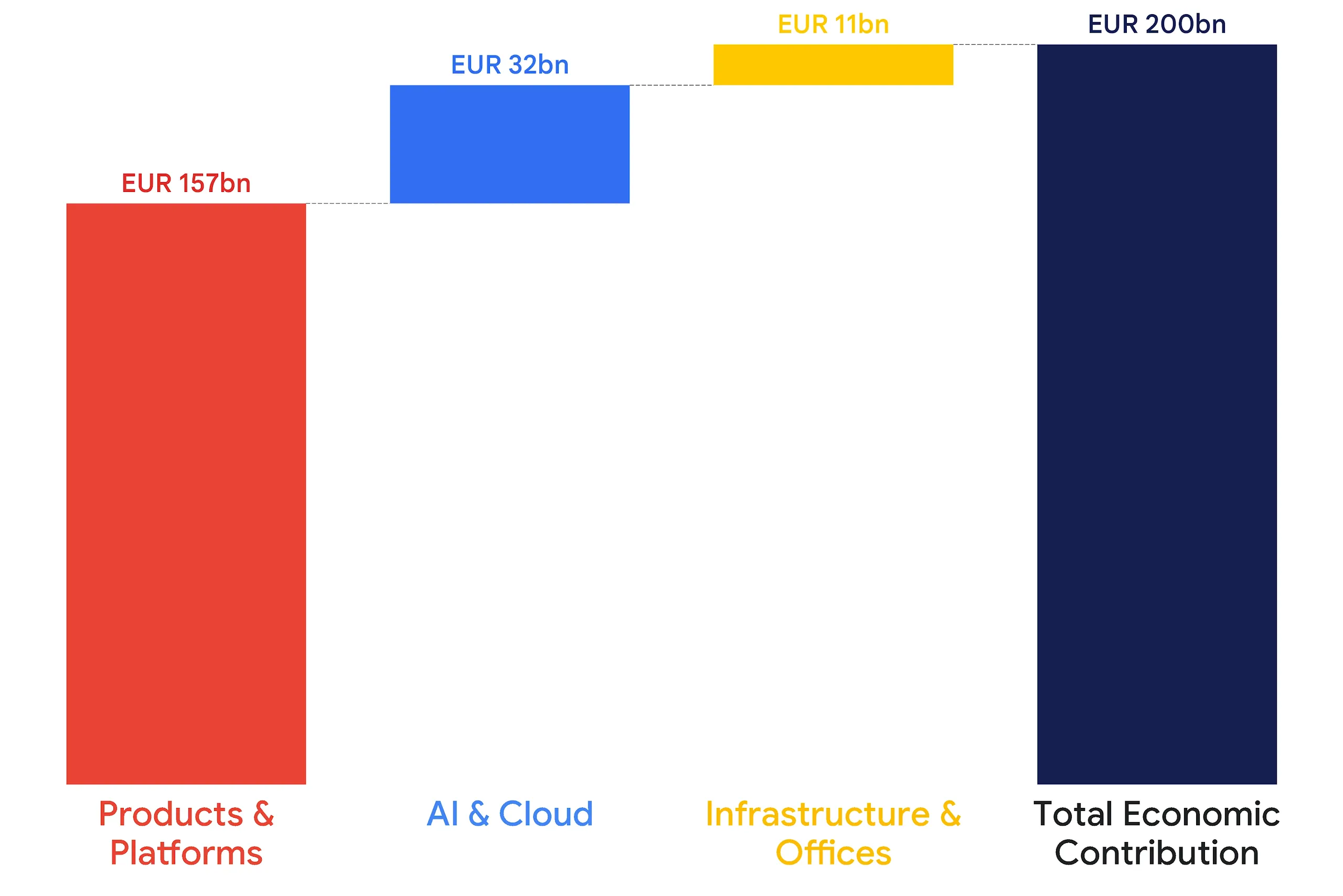
Implement Consulting Group’s research estimates that in 2025 alone, Google’s products, AI & Cloud technologies, infrastructure, and offices contributed more than €200 billion to the EU GDP, representing 1% of total EU GDP. This impact is broken down across three areas.
-
Platforms and Products contribution
€157 billion
Google Platforms and Products, like Search, Ads, Android, Play, Chrome, YouTube and more, enabled European businesses to reach customers, creators to monetise content, and users to access information, services, and markets more efficiently.2
-
AI & Cloud contribution
€32 billion
Google AI & Cloud technologies enabled businesses, public institutions, and developers across the EU to improve their productivity, scale their services and accelerate their innovation.3
-
Infrastructure & Offices contribution
€11 billion
Google’s data centres provide the cloud and AI compute capacity that are the backbone of digital services that enable businesses, public institutions, and individuals across the EU. Our offices and data centres help boost local economies and create jobs.4
European businesses of all sizes are innovating and staying competitive, with help from Google AI
GERMANY
Deutsche Bank delivers AI-powered financial research
At Deutsche Bank, the intelligent AI assistant dbLumina helps analysts with researching critical financial information. Built with Gemini Enterprise, it seamlessly consolidates and structures data and reports from across a wide range of sources. The result? More time for in-depth analysis and expert evaluation, and more of what clients are looking for: personalized and future-oriented advice.
FRANCE
Renault Group is reinventing French automotive production with AI
In Renault Group's factories, Google AI helps prevent breakdowns and detect manufacturing defects in real time. Assembly lines are becoming more flexible and reliable, factory downtime and production defects are down, and efficiency is up. AI is catalyzing performance in support of the French automotive industry.
ESTONIA
ALPA Kids is using AI to help children learn in their own language
Estonian scale-up ALPA Kids uses Gemini to build a system that optimises their marketing spend based on weather forecast & holidays, delivering 20% more installs for the same budget. Gemini and Google Veo also support their localization and animation processes. Together, these efficiencies have reduced go-to-market time from three months to three weeks, letting ALPA Kids expand into 15 new countries a year.
POLAND
Ryvu Therapeutics cuts false positives in drug discovery by 50% with Google Cloud
Polish biotech Ryvu Therapeutics uses Google Cloud to scale its molecular dynamics simulations for oncology drug discovery. The implementation of Google Cloud has transformed the pace of discovery at Ryvu, enabling a 2x speedup in simulation times and cutting false positive drug structures by 50%. The data science team saves 5-10 hours a week previously spent on manual data preparation that can be redirected to building more advanced predictive machine learning models.
spain
Idoven helps doctors detect heart diseases earlier with Google Cloud
Cardiovascular disease kills 17 million people each year. Spanish health technology company Idoven developed an AI diagnostic platform built on Google Cloud that reads ECGs with expert-level accuracy. In about eight minutes, the AI can make the same accurate diagnosis that takes a cardiologist eight hours, using traditional, manually-intensive methods. The technology has been shown to cut false positive arrhythmia detections by up to 98% compared to manual diagnosis.
IRELAND
IPERA is using Gemini to scale their skincare brand globally
After expanding to 100 stores in Ireland, natural skincare brand IPERA rebranded to bring its local success to an international stage. Founder Danilly Carvalho used Gemini Canvas as a co-creator to generate a new name, visual identity, and web presence, and used Gemini Notebook for market research to enter new countries. Within months, online sales increased by 45% and IPERA expanded distribution to seven new markets. Explore more stories of how European small businesses are using AI.
Google’s impact across the EU
Google Offices
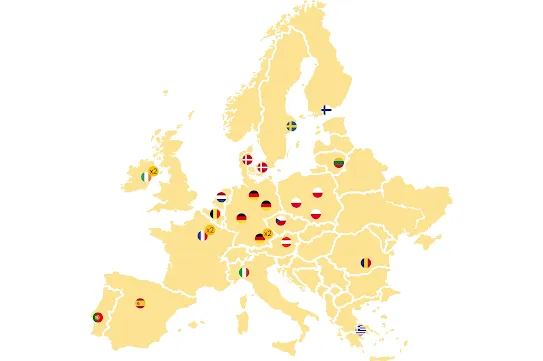
26 offices in the EU
Today, Google has 26 offices across 17 EU member states, with its EMEA headquarters located in Dublin, Ireland.

Data Centres
8 data centres across the EU
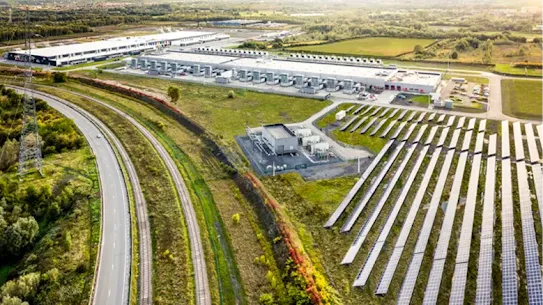
Google owns and operates eight data centres across the EU, with eight more currently under development, providing customers with highly secure digital infrastructure.
Google data centres in Europe (incl. UK) run on 83% renewable energy on average, with investments in wind and solar adding new carbon-free electricity to the European grid.
Google data centres in Europe (incl. UK) run on 83% renewable energy on average, with investments in wind and solar adding new carbon-free electricity to the European grid.
Digital Skilling
13 million trained on digital skills
Since 2014, Google has trained over 13 million people in the EU on digital and AI skills to enable them to develop their career or grow their business. Learn more.
Community impact
€205 million in philanthropic funding
In 2025, Google and Google.org contributed $205 million to EU communities via philanthropic cash grants, employee giving, and in-kind product donations, in combination with over 74,000 volunteering hours.
Explore the 2025 EU Google Economic Impact Report
1 Disclaimer: This report has been prepared by Implement Consulting Group. The purpose of this Report is to demonstrate Google’s impact on the EU economy through its products & platforms, AI and cloud technologies, infrastructure, offices and social contributions.
The authors of the report are Anders Thor Lundberg, Mathias Pedersen, Mads Sigurd Franch Andersen, Johan Stokholm Sørensen, Eva Rytter Sunesen, and Martin H. Thelle. Martin H. Thelle is a senior partner in Implement’s Economics Practice, while the other authors are economists in the same practice, all based in Copenhagen.
All information in the Report is derived from or estimated by Implement’s analysis using proprietary and publicly available information. Google has supplied use cases and information from internal financial accounts. Unless otherwise stated, all figures relating to Google's economic impact in the EU are estimates modelled by Implement rather than data reported by Google. Impact numbers are rounded down to the nearest whole billion EUR. In addition to the primary market research and publicly available data, Implement’s analysis is based on third-party data provided by Google. In preparing the Report, Implement has, without independent verification, relied on the accuracy of the data made available by Google. Where information has been obtained by Implement from third-party sources, other than Google, this is clearly referenced in the footnotes. The Report is based on work conducted from May to September 2026. Implement will not make any representation or warranty as to the correctness, accuracy or completeness of the contents of the Report or as to the sufficiency and/or suitability thereof for the reader’s purposes, nor does Implement assume any liability to the reader or any other legal entities for any losses or damages resulting from the use of any part of the information in the Report.
2 The impact of Google Products & Platforms has been calculated through analysis of estimated economic benefits realised by the users of Google products, the economic activity of developers, publishers, and creators enabled by the product, and the economic value that advertisers have from paid and organic Search and Ads traffic. For the full methodology, view the report’s Annex.
3 We employ a conservative approach to estimating the non-overlapping combined impact of AI and Cloud. The productivity impacts of AI and cloud adoption combine academic studies of the productivity impact of AI and cloud adoption by European businesses with cloud and AI spending data. For the full methodology, view the report’s Annex.
4 The GDP contribution from Google's employees, temporary workers, vendors and contractors (TVCs) and office-related operations across the EU is estimated using input-output modelling based on OECD Inter-Country Input-Output (ICIO) tables, extended with employment and labour cost data from the OECD Structural Analysis (STAN) database. The GDP contribution from Google data centres in the EU is based on Google, which estimates the economic impact of Google’s data centre operations and value chain using an input-output model developed by IMPLAN. For the full methodology, view the report’s Annex.